|
05 APRIL 2006 | TNG
Canada Local 30400 |
Media
& Communications Workers of Alberta
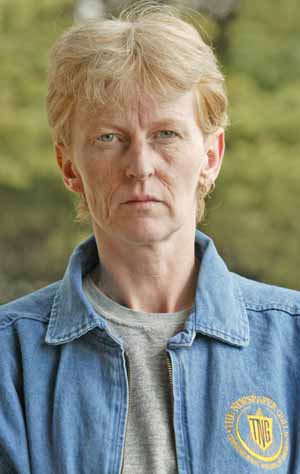
Photo: David Olecko
PUTTING
A WOMAN
IN HER
PLACE
Arbitrator overrules
publisher's
choice
for apprentice pressman
By DEBORAH RICHMOND
TNG Canada Web Editor
Janice Contant became a rare creature on Monday, when she
started her new job as apprentice pressman at the Red
Deer Advocate. She is the first woman press operator at the central
Alberta daily and one of only a handful in North America,
if not the world.
Although it required an arbitrator to confirm that she was
entitled to penetrate the upper echelon of the pressroom,
she's not gloating about winning the grievance against her
employer.
"I'm just glad that, in the end, I won. It's not about
money or a better position. What's important is the principle," says
the 37-year-old. "I just want to open a doorway for
women. Hopefully someone will follow me."
While the victory itself might be dismissed
as a yawn in the ages-old struggle for gender equality, what
was trotted out in testimony and evidence during eight days
of hearings over 15 months is a compelling saga of sexism,
jealousy, harassment, deception and abuse of power.
• • •
ON THE FACE OF IT, arbitrator
Timothy J. Christian had before him a straightforward case:
Janice Contant, with three years as a paper
handler under her belt, applied for the position of apprentice
pressman in late 2003. But she was passed over in favour
of a male colleague who had been judged as equally qualified.
The reason, production manager Derek Olinek told her when
he called with the bad news, was that Scott Wood was considered
more physically capable of doing the job.
If true, this would be a violation of not only human rights,
but the collective agreement. It stipulates that, when two
or more candidates for a position are equally qualified,
the job goes to the employee with more seniority. In this
case, that would be Contant.
Olinek, who headed up the interview process and did the
reference checks, made it clear in his memorandum to publisher
Fred Gorman why he was recommending that the man get the
job:
"With both having worked in
our pressroom for three years there is little doubt
in my mind that the two of them are equal in qualification.
I believe, however, that physical ability is the determining
factor."
But Gorman tossed the arbitrator a curve ball when he testified
rather late in the game that it was his decision to reject
Contant because of her poor attitude. Physical ability had
nothing to do with it, he insisted.
"This was a lengthy proceeding and it was not until
the evidence of the last witness (Gorman) ... that the true
basis for the employer's decision became apparent," writes
Christian. "It became clear ... that the employer abandoned
any claim that the grievor's size or physical ability would
prevent her from performing the job functions."
During cross-examination by union lawyer Nelson Roland,
the publisher admitted he had sought the advice of the company's
solicitor, who had cautioned Gorman that human rights law
prohibits the rejection of a job applicant on the grounds
of physical size or limitations.
"Instead," writes the arbitrator, "Mr.
Gorman had to review the paper trail and come up with a
legally acceptable, alternative, reason for refusing to
appoint the grievor."
"Mr. Gorman apparently cleared his mind of the concerns
over physical ability and instead focused on the grievor's
attitude," says Christian.
In reviewing notes made by Olinek about the reference checks,
Gorman essentially ignored positive assessments from other
managers and seized upon a negative appraisal from foreman
Don Ton, Contant's immediate supervisor.
But, the arbitrator points out, Olinek had alerted Gorman
in his memo that there might be a problem with Ton's appraisal:
"During the interview process,
Janice pointed out that there seems to be a personality
conflict between her and Don Ton that she implied might
influence his opinion of her abilities."
In laying out the union's case, Roland was succinct about
why Gorman was wrong to have latched onto that appraisal:
"The employer has Don Ton, a
sexist individual who brought personal business into the
workplace. Don Ton went from being a big supporter (of
Contant) to someone who gave her an F on attitude and said
he would not rehire her.
"Mr. Ton's opinion was the one
the publisher relied upon without qualification and despite
the fact there were numerous red flags, which should have
suggested caution in accepting what Ton said about the
grievor. The fact that those red flags were ignored indicates
how incredibly biased was the judgment with respect to
the attitude of the grievor. It shows how suspect were
the purported reasons for rejecting the grievor."
The arbitrator, who observed that
it was unfair of Gorman to not have given Contant the opportunity
to counter the negative reference, says the publisher "ought
to have taken steps to ensure that the personal differences
between Mr. Ton and the grievor did not adversely affect
his judgment."
"In the result, I am of the view that Mr. Gorman did
not fairly appraise the abilities of the grievor and could
not reasonably conclude that Scott Wood was better qualified
than the grievor to be appointed as apprentice pressman," writes
Christian.
He concludes that "the review by Mr. Gorman of the
reference check notes was not adequate to set aside the assessment
of Mr. Olinek" that the two candidates were "equal
in qualification" and orders the employer to appoint
the grievor to the position of apprentice pressman.
• • •
IT HAS BEEN SEVERAL
WEEKS since the arbitrator's
decison and Janice Contant admits in an interview that she's
feeling some anxiety about the approaching Day One as apprentice
pressman.
It's not that she's expecting to
have to work alongside a bunch of sore losers. Quite the
opposite. Since the arbitrator's decision became general
knowledge at the newspaper, there's been "quite a
positive reaction from the other workers."
No, what she's worrying about is
the "day" part
of "Day One." As in, "I've been on nights
for six years. I'm apprehensive about moving to day shift."
The reason the workplace atmosphere is no longer her biggest
concern is that there's a night-and-day difference from what
she encountered six years ago.
Since starting in the Advocate's mailroom in 1995, Contant
had worked her way up to a top-level inserter. When the company
posted the position of pressroom helper (a.k.a. 'flyboy'
or paper handler), the mechanically-inclined Contant saw
it as an opportunity for career advancement.
It would be a physically demanding
job and she knew that the prevailing wisdom was that women
don't have the upper body strength for it. But, for Contant,
who'd grown up with four brothers on a farm where she was "one of the boys," it
was no big deal to put in a hard day of manual labour doing
what was traditionally men's work.
Despite being warned by a mailroom supervisor that women
would never be hired to work in the pressroom, she applied
for the position. As a member of her local union executive,
she knew that their collective agreement supplements human
rights law and prohibits hiring practices that discriminate
on the grounds of a person's sex, size, physical characteristics
or abilities.
"I was interviewed," recalls Contant, "but
they made it pretty clear I wasn't going to get the job."
When a male was hired off the street,
she filed a grievance. She wound up dropping it, however, "because
they gave me the position after firing the guy they'd hired
because he couldn't do the job."
"Once I got into the pressroom (as a helper), there
was lots of tension," recalls Contant. "I didn't
want to make things worse, so I just ignored him."
"Him" is Don Ton, the night
foreman who no longer works at the paper, but who eventually
became a key character in the 2004-2005 arbitration hearings.
Contant's move into the pressroom put her under the direct
supervision of Ton, who was at first tolerant of her presence
there. In fact, he was the author of a largely positive performance
review three months after she started the job.
But things started to change in 2001, when she took up with
co-worker and Ton's best friend, Jody Foon. As dating progressed
to a steady relationship, Ton's jealousy grew along with
it. So did Ton's haranguing of his friend and harassment
of the girlfriend who was commanding so much of Foon's time
and attention.
• • •
READING THE ARBITRATOR'S
RECAP of testimony
he heard from Foon and Contant, it's easy to detect the rising
level of resentment and hostility emanating from Ton:
"Mr. Foon testified that Mr.
Ton had a number of discussions with him about his relationship
with the grievor. He would ask Mr. Foon what the grievor
meant to him and why he was with her. ... It was clear
that Mr. Foon was troubled by the persistence of Mr. Ton
in raising personal issues concerning his relationship
with the grievor at work. ... Mr. Ton clearly did not like
the relationship between the grievor and Mr. Foon and actively
attempted to end it."
Contant testifies "that Don Ton never made her feel
comfortable.... the guys would get together and go for lunch
and would never ask her to go with them," writes Christian.
There were occasions on which Ton's vindictiveness was apparent:
"The grievor testified that,
to get at Jody through her, Don Ton said that the grievor
had to move all (press) shafts on all (paper) roll changes.
Don Ton instructed the guys to wait until the grievor got
there to move the shafts. While the grievor was in the
process of moving out a shaft, Don Ton said to her that
she would have to move the shafts on all the roll changes.
On the shift she moved about six shafts. The grievor testified
that she did a roll change with Jamie and that, while Jamie
can move a shaft with one hand, he waited for the grievor
to come to do the shaft change."
Christian also heard about the "troubling" way
the resentful boss would misuse his authority:
"While Don Ton would send several
pressmen for coffee or lunch, he would give the grievor
only one (15-minute) break (per shift). The grievor told
him that she was entitled to three breaks. Don Ton said
that he was the foreman and he would decide when the grievor
got a break. ... One night the grievor and another employee
worked for 5-1/2 hours with no break. Don Ton said that
he could not stop the press and could not allow any breaks.
The grievor filed a complaint and that did not happen again."
Then the arbitrator was told about a chilling development
involving one of the couple's co-workers:
"The grievor testified that,
at one time, John Hoang and her got along OK. However,
John Hoang started doing strange things. When Jody and
the grievor built their new house, John Hoang said he was
going to find out where they lived.
"Then John started telling Jody
whose cars were parked at the grievor's house. It became
clear that John Hoang was stalking them."
• • •
FLASH FORWARD TO OCTOBER
2003: Don Ton
is answering the production manager's questions about Contant's
suitability as a candidate for apprentice pressman. He is
asked how she gets along with others. Response: "Doesn't
talk to Don or John, won't even say 'Hi'." He also
says that Contant "doesn't
try to get along. Moody."
In his arguments, union lawyer Roland
points out that "The
comments of Ton ... did not explain that the grievor did
not speak to John because she was concerned he was essentially
stalking her.... Without an explanation, she seemed anti-social."
Contant, says the arbitrator, chose
not to confront her supervisor over his comments and behaviour. "She
started avoiding Don Ton and spoke to him only on a work
level. She had no personal conversations with him."
The overall picture drawn by Ton was that of an employee
with a poor attitude, an unwillingness to communicate and
be a team player.
Asked about the candidate's weak
points, Ton replies that Contant "seems more a team
member with the mailroom (more ladies) than teamwork/communication
in pressroom."
Roland suggests that comment "should
have caused some concern. It should have indicated that
there may be gender discrimination going on with Ton."
In his summary, Christian observes
that it took three months for the company to provide a
uniform for Contant, who wore her own clothing in the dirty,
ink-spattered pressroom. Nor were there facilities where
she could change and shower, which led to "a lot of
jokes about whether she would use the guys' locker room."
• • •
TODAY, JANICE CONTANT
ONLY CHUCKLES about
the fact the company has to — quite
willingly, as it turns out — provide
her with a place to change and shower.
A lot of other things have changed, too. With Ton gone,
she no longer has to contend with sexism on a regular basis
or a boss who despises her for personal reasons.
Jody Foon has left the paper and found work elsewhere as
an electrician. And, they are engaged to be married.
It's obvious that Contant just wants
to get on with her life; she refuses to dwell on the lengthy
battle to win what was rightfully hers. "I'm glad it's over. It's such
a relief," she says with a sigh.
She wants it known though that she could never have hung
in there if she'd had to go it alone:
"Nelson Roland (counsel for
TNG Canada) gave me a lot of hope and support. Luis Rufo
(secretary-treasurer of the Local) was 100 per cent behind
me."
Contant notes that getting the job she wanted and deserved
wasn't the only positive outcome of the arbitration.
"It shows the union can work;
it really can."
|