

2013.05.31
Harper ignores outrage of 200,000+ Canadians
"It is of paramount importance in a democracy that there be no state interference with journalism — it's what separates us from totalitarian regimes."
With that succinct assessment of what's wrong with Bill C-60, CWA Canada Director Martin O'Hanlon joined with the union's largest Local, the Canadian Media Guild (CMG), and other journalism advocates to raise the alarm about the Harper government's plan to undermine the independence of the CBC.
"We want the Canadian people to react as quickly as possible to bring the government to its senses," Arnold Amber, president of Canadian Journalists for Free Expression said at a news conference in Ottawa. The federal budget bill, which would end the arm's-length relationship between government and more than 40 crown corporations, was given only cursory examination in committee and is to be voted on in Parliament on June 4.
CJFE said it strongly believes that the more information the public has about how our country functions, the better. The present ongoing saga of financial malfeasance in the Senate is a vivid example of that.
"For decades, there has been the delicate balance between government control and a truly free, independent public broadcaster,” said Amber, formerly a producer at the CBC. “This bill crashes through that, and could seriously affect what the CBC reports on, how it approaches programming, and how Canadians will think about the integrity of the CBC."
"The government already has powerful influence over the CBC because it appoints the president and board members and sets the budget," said O'Hanlon. "Bill C-60 would take that influence to a troubling new level, giving the government unprecedented control over the operation of the public broadcaster."
"It's bad for journalism and it's bad for democracy."
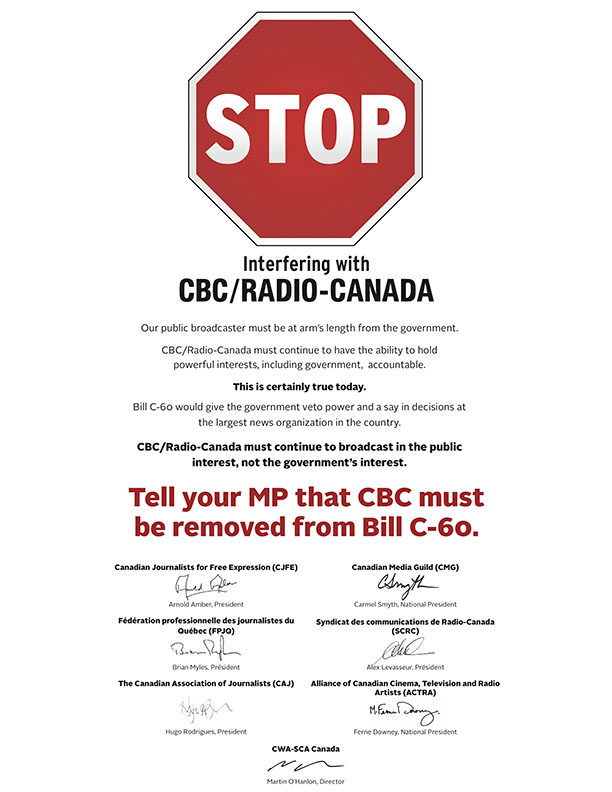 The news conference coincided with the publication of full-page ads in the Globe and Mail and La Presse, urging Canadians to tell their MPs that CBC/Radio Canada must be removed from Bill C-60 because the public broadcaster "must continue to have the ability to hold powerful interests, including government, accountable."
Co-sponsoring the ad were the Fédération professionnelle des journalists du Québec (FPJQ), the Synicat des communications de Radio-Canada (SCRC), the Alliance of Canadian Cinema, Television and Radio Artists (ACTRA), and the Canadian Association of Journalists (CAJ).
Friends of Canadian Broadcasting, a non-partisan watchdog group that at the outset accused the Harper government of wanting to create the Conservative Broadcasting Corporation, teamed up with Leadnow.ca and SumOfUs.org to gather more than 130,000 signatures on FREE CBC petitions that were delivered to Parliament Hill. That number had grown to more than 200,000 by the end of May. Avaaz.org launched and is still running another petition campaign.
Leadnow.ca reported that thousands of its supporters heeded their urging and called their Conservative MPs as well as those who sit on the finance committee, which is reviewing the omnibus budget bill before it returns to the House for a general vote.
"This isn’t about money," said Jamie Biggar, Executive Director of Leadnow.ca. The CBC has demonstrated that its wage increases have consistently lagged behind the industry average. It’s about the government’s wish to control the CBC.”
In a letter to the prime minister, 16 respected names in Canadian journalism expressed their "deep concern" that Bill C-60 would "give the government a veto over CBC's collective agreements" which contain conditions of work that "currently provide assurance of the integrity of CBC as an independent national public broadcaster, as required under the Broadcasting Act."
They point out that the Broadcasting Act states that the CBC "shall, in the pursuit of its objects and in the exercise of its powers, enjoy freedom of expression and journalistic, creative and programming independence."
"As you know," they wrote, " this statement places the CBC on a par with its counterparts in other free and democratic countries. It is what makes the CBC a public broadcaster — as opposed to a state broadcaster. Independence from governmental interference is the key distinction between the two — throughout the world."
Hubert Lacroix, the government-appointed CEO of the CBC, warned in a letter to the Commons finance committee that the bill might "give rise to conflicts with the Broadcasting Act and the Charter and compromise the Corporation's independence. This could potentially embroil the government, our corporation, and its unions in litigation."
Lacroix noted that the CBC is already accountable to taxpayers in its reports to Parliament, and that salary increases over the past seven years have averaged 1.9 per cent, compared to three per cent in the private sector.
Finance Minister Jim Flaherty said in response to the letter: "The CBC may think it is a special, independent, Crown agency. This is wrong.
"All Crown agencies have a responsibility through ministers, back to Parliament, to the people of Canada. They can't do whatever they want, particularly with taxpayers' money. They can't just go off and pay their executives and pay everybody else whatever they want to pay them."
The Canadian Media Guild, which represents thousands of workers at the CBC, said Flaherty and the Harper government have ulterior motives:
"Bill C-60 is not simply about controlling costs by putting a lid on wages and benefits at Crown Corporations, including the CBC. This is merely the wedge the government is trying to hammer between ‘taxpayers’ and public workers, making decent wages and benefits a matter of scorn and jealousy instead of a bar of decency to which all people working in Canada could aspire.
"C-60 falls squarely in the Conservative strategy to shut down independent voices – and information, analysis and discussion – that cannot be controlled from the Prime Minister’s Office."
John Doyle, the Globe and Mail's television columnist, noted that "This government's reach into the CBC inner working comes at an odd time. The CBC is a wounded, bewildered beast staggering round, trying to figure out how to survive with a hostile government and an aggressive commercial broadcast sector that wants it dead.
"Much of what Flaherty says echoes what Sun News has been braying about the CBC: When it cannot find bias or poor reporting, it complains about money, salaries and the CBC’s 'money drain'. In this instance, the minister sounds rather like a ventriloquist’s dummy, with Sun News being the ventriloquist.
"The great myth perpetuated by Sun News, and now spoken by Flaherty, is that CBC is an out-of-control spending machine. This is mere posturing, as ugly as it is untrue."