|
Tom Ludwig photos
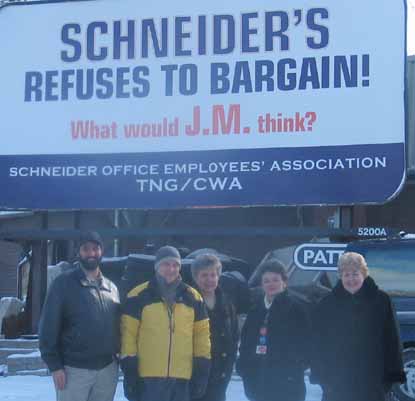
The bargaining team (from left)
– Art Lacroix, Bruce Hawkings, Marilyn Mackenzie, Crystal
Ward and Carol Madter
– shows off one of the billboard ads the Local has
placed within sight of executive offices at Schneider Foods.
16 February 2005
Strike/lockout of office staff seems inevitable
at Schneider Foods
Schneider
Office Employees' Association | TNG
Canada Local 30009
Guild members at Schneider Foods Corp. have had enough of
the company's strong-arm tactics; they're preparing for a
strike or lockout early next month.
Art Lacroix, president of the 166-member
Schneider Office Employees' Association, says most of the
workers at the head-office operation in Kitchener, Ont.,
no longer buy the company's patronizing mantra of "Trust
us, it will all work out." Actions
to the contrary have spoken far louder than those assurances,
especially since the food products company was taken
over in 2003 by the anti-union Maple Leaf Foods.
Schneider management has brought
few concrete proposals to the bargaining table since the
office employees' contract expired on Oct. 31, 2004, says
Lacroix. Four bargaining sessions and two meetings with
a conciliator yielded little but requests by the company
for a No Board Report, which has now been granted. That
will put the company and the union in a "free" position
at 12:01 a.m. Monday, March 7.
It is widely anticipated that Schneider will try, once again,
to take advantage of the free position to impose new terms
and conditions that will negatively affect job security,
pensions, pay and benefits. This time, however, Guild members
are not in the mood to acquiesce.
In a communique to union members
this week, the bargaining team (Lacroix, vice-president
Marilyn Mackenzie, Bruce Hawkings, Crystal Ward and Carol
Madter) reported that Schneider management's "counter
proposal was heavy on absolute control and flexibility for
the company but light on any improvements for you." The
team advised members that "unfortunately, we are unable
to respond to the proposal because of all the unknowns and
answers are no nearer today than when we started negotiations
many months ago."
Because of the company's refusal to provide information
required to bargain salary, pension or health benefits, TNG
Canada's counsel, Nelson Roland, is filing a bad-faith bargaining
complaint with the Ontario Labour Relations Board.
The bargaining team was given a strike
mandate on Dec. 11 when 63 per cent of those voting favoured
taking that job action if necessary, says Lacroix. The Local's
mobilization committee has been busy distributing T-shirts
and buttons and generally getting members geared for job
action on March 7. The union has placed huge ads on billboards
outside the Schneider plant and within sight of the executive
suite. News releases and radio advertising are in the works.
Secondary picketing will likely take place prior to the 7th.
A survey of Guild members prior to the start of negotiations
revealed their biggest concerns are job security and severance
packages. That isn't surprising, says Lacroix, considering
many of the office staff are long-time employees who do not
want to leave Kitchener.
Guild members, who include administrative,
finance, information technology and clerical workers, have
watched with growing dismay as the Schneider and Maple
Leaf merger took effect. The "rationalization" led
to (non-unionized) sales staff and then marketing department
employees being transferred to Mississauga. The IT staff
who are members of the Guild Local have been told they
will be relocated by June 2006, but their destination has
yet to be decided.
Lacroix says the members' position could be summed up as: "We're
tired of the games. Let's get a contract that gives us
stability and certainty through the takeover process."
The Guild is seeking increases of four per cent in each
year of a new contract, regardless the term, which has yet
to be discussed. The office employees' salary grid currently
ranges from $21,000 to $76,000.
The employees are also intent on
winning indexed pensions and improved health benefits.
It was the latter that took a big hit in the last round
of negotiations, says Lacroix. "The
company put us in flex benefits and reserved the right to
change the plan when it came up for renewal." Now Schneider
wants to select the provider, determine the coverage and
set the employer/employee contributions, he says.
Another sore point for the workers is pensions, he adds.
The company has a history of making questionable changes
to the pension plan. The Guild Local is considering filing
a class-action suit regarding what it considers to be the
company's inappropriate use of pension plan surpluses.
Lacroix says employees are losing patience with a company
that does not honour its contracts, refuses to abide by pay
scales agreed to in collective bargaining, and that generally
thumbs its nose at workers' concerns. The Local sees an average
of 18 grievances a year and most go to arbitration, he notes.
|